
Healing Mother-related Restricted Self-Expression
What Restricted Self-Expression Really Feels Like
Restricted self expression feels like an inner sense of limitation around speaking freely, choosing independently, or growing in one’s own direction. It can show up as hesitation to express opinions, discomfort asserting preferences, or a quiet fear of stepping beyond what feels emotionally permitted. Growth may feel possible in theory, yet constrained internally.
Rather than obvious suppression, this pattern is often subtle. There may be an internal braking system that pauses expression, delays decisions, or minimizes personal desires to maintain emotional harmony.
How Restricted Self-Expression Develops Over Time
This pattern commonly develops in early relationships where control, overprotection, or emotional enmeshment were present. When guidance crossed into intrusion, or care limited freedom, the nervous system learned to associate self expression with emotional risk.
Over time, choosing independently may have felt unsafe, disloyal, or destabilizing to connection. Personal growth became something to manage carefully rather than allow naturally. Even later in life, the body may continue to restrict expression automatically.
Signs of Restricted Self-Expression in Daily Life
• Difficulty expressing personal opinions or needs.
• Guilt or fear when making independent choices.
• Feeling held back from growth or exploration.
• Discomfort setting boundaries.
• Delaying personal goals despite inner readiness.
A Gentle Healing Approach for Restricted Self-Expression
Healing restricted self expression begins by acknowledging that this pattern once supported emotional safety. There is no need to push against it. Safety returns through gentle awareness, allowing expression and choice to arise without threat.
The body gradually learns that growth and connection do not cancel each other.
Step 1: Grounding the Nervous System for Restricted Self-Expression
Notice the present moment as it is.
Feel the natural rhythm of your breath.
Sense the surface supporting your body.
Allow awareness to rest here without trying to change anything.
Step 2: Anchoring the Experience of Restricted Self-Expression
Bring attention to where restricted self expression is felt in the body.
It may appear as tightness, constriction, heaviness, or holding back.
Notice its location, shape, or intensity.
Allow the sensation to exist without attempting to shift or resolve it.
Step 3: Processing Subconscious Patterns Behind Restricted Self-Expression
Gently begin the following statement, either aloud or mentally.
Repeat the statement slowly and with awareness.
“I recognize my experience of restricted self-expression.”
Repeat this statement 21 times.
Remain observant.
Memories, emotions, images, or bodily sensations may arise.
There is nothing to analyze or fix.
Simply notice what surfaces and allow it to pass naturally.
Step 4: Clarifying Core Associations Linked to Restricted Self-Expression
After completing the first round, ask yourself quietly.
Did expressing myself feel unsafe.
Did growth feel limited by emotional closeness.
Did choosing for myself feel risky.
Allow clarity to surface naturally, without forcing answers.
Once a specific association becomes clear, such as fear of separation, guilt around independence, or discomfort with growth, continue with the recognition statements using that exact association.
Example:
“I recognize my association of restricted self-expression with fear of separation.”
Repeat 21 times.
“I recognize my association of restricted self-expression with guilt around choosing for myself.”
Repeat 21 times.
Pause after each round.
Remain present with the breath and body.
Step 5: Integrating Freedom Beyond Restricted Self-Expression
Once emotional neutrality, softening, or clarity is felt, gently introduce the integration affirmation.
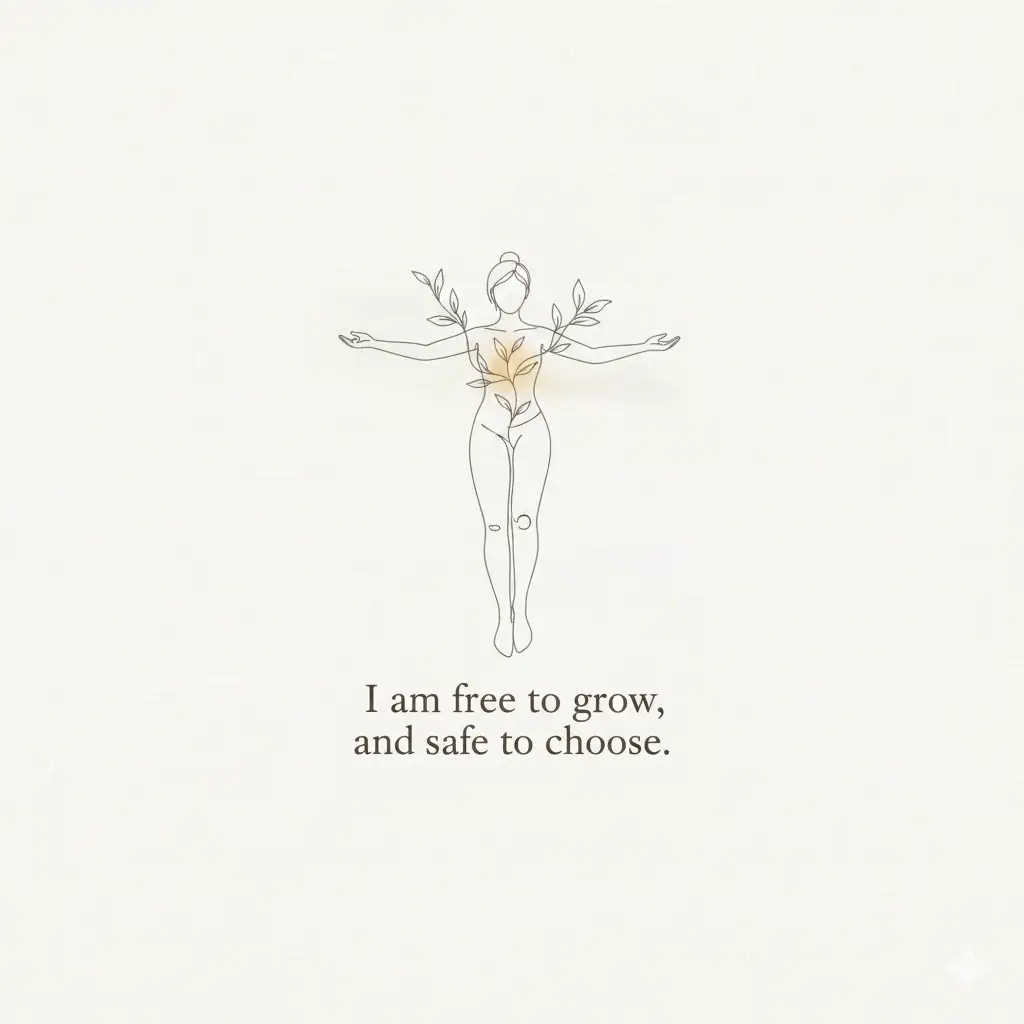
“I am free to grow, and safe to choose.”
Repeat this affirmation 21 times daily for 21 days.
This affirmation is not used to convince the mind.
It is used to stabilize a new internal reference point after recognition and integration.
Possible Experiences While Healing Restricted Self-Expression
You may notice emotional release, subtle increases in confidence, clearer awareness of personal desires, or moments of neutrality. Some days may feel expansive, while others feel unchanged. These experiences are natural and reflect integration unfolding at its own pace.
Life After Healing Restricted Self-Expression
As restricted self expression integrates, expressing yourself may feel more natural and less emotionally charged. Choices can arise with greater ease, and growth may feel supportive rather than threatening. Independence becomes an internal permission rather than a source of conflict.
Restoring Safety Beyond Restricted Self-Expression
Safety is restored through repeated moments of allowing expression and choice without consequence. Each gentle acknowledgment reinforces freedom that is steady, grounded, and self supported.